
From Alchemy to Accelerators
“What is below is like what is above, and what is above is like what is below.” — The Emerald Tablet attributed to Hermes Trismegistus

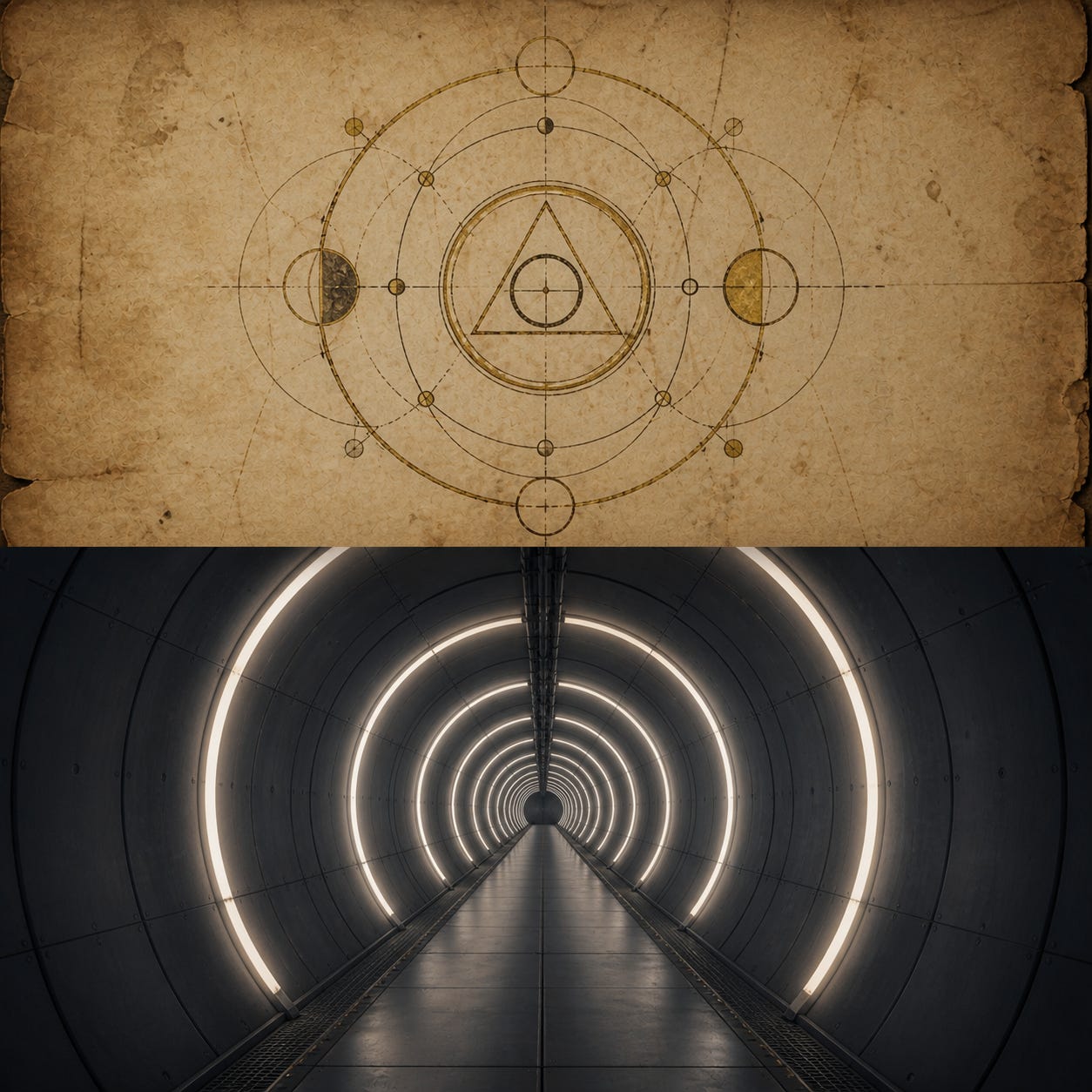
For most of human history, we tried to understand the world without knowing how it actually works.
Long before equations, instruments, and experiments, people used symbols, stories, and metaphors to make sense of the world. These early frameworks were not foolish guesses; they were the best available tools for thinking about reality before its mechanisms were understood.
Alchemy is one of the clearest examples of this process.
Often dismissed as superstition or pseudoscience, alchemy was in fact an early attempt to understand transformation. Alchemists were not simply trying to get rich by turning lead into gold. They were exploring the nature of matter and methods of transformation using the symbolic language available to them at the time.
In an age without knowledge about chemistry or particle physics, alchemy offered a way to think about how substances change and how order emerges from chaos. Metals were seen as living processes rather than static objects, slowly evolving within the Earth toward greater refinement. Gold symbolized not just wealth, but completion, stability, and purity.
Because alchemy blended observation with symbolism, it operated on more than one level. Physical experiments were paired with metaphors about purification and transformation. To modern thinkers, this mixture can seem illogical. But historically, it reflects a deeper truth: understanding often begins in metaphor before it arrives at mechanism.
This pattern repeats throughout the history of knowledge. Before gravity was mathematically described, it was imagined as an invisible pull. Before electricity was understood, it was likened to fluid or fire.
Metaphors do not explain how something works, but they point attention in the right direction. For example, the “solar system” model of the atom—where electrons orbit a nucleus like planets circling the sun—helped scientists visualize atomic structure long before quantum mechanics provided a more accurate, but less intuitive, description. Such models made the unseen more tangible and allowed researchers to ask better questions as understanding advanced.
As science advanced, chemistry revealed that lead and gold are fundamentally different, not stages of the same substance. With this discovery, alchemy lost credibility. Its symbolic language was mistaken for literal explanation, and it was dismissed as a failed science rather than recognized as an early stage of inquiry.
Yet the story did not end there.
In the 20th century, nuclear physics revealed that elements can, in fact, be transformed, though not by mixing substances or purifying metals. By changing the structure of an atom’s nucleus, one element can become another. Scientists succeeded in creating small amounts of gold from other elements using particle accelerators and nuclear reactors.
These results do not vindicate alchemy’s methods, but they do validate its intuition: matter is not fixed. Transformation is possible, though far more complex than early thinkers imagined.
This is a crucial distinction. Alchemy was wrong about how transformation occurs, but not wrong about whether it can occur. The metaphor preceded the mechanism.
Understanding this helps us avoid a common mistake: judging early ideas solely by modern standards. When metaphors are treated as failed explanations rather than stepping stones, we miss how knowledge actually evolves.
Science itself depends on provisional models. Early atomic diagrams, wave analogies, and even terms like “particle” and “field” are metaphors refined over time. As understanding deepens, metaphors are replaced or formalized. But without them, progress would stall.
This insight encourages intellectual humility. Ideas once ridiculed may later be reframed. Ideas once celebrated may later be revised. Knowledge does not grow in straight lines, but through cycles of intuition, testing, correction, and refinement.
The deeper lesson of alchemy is not about gold. It is about patience with uncertainty. Early thinkers sensed that reality was dynamic and transformable. They lacked the tools to explain it precisely, but they were not wrong to suspect that deeper processes were at work.
This lesson applies beyond science. Human understanding of mind, society, and meaning often begins in metaphor. Concepts like “energy,” “balance,” “growth,” and “alignment” appear first as symbolic language before being clarified—or challenged—by research and experience.
Dismissing these ideas too quickly risks closing doors prematurely. Accepting them uncritically risks confusion. The task of mature inquiry lies between these extremes: respecting intuition while demanding evidence.
This balance helps us evaluate the modern scientific worldview. Quantum physics shows that reality behaves in ways that defy everyday intuition. Complex systems theory reveals that order emerges from interaction rather than control. Both fields require new metaphors before they can be fully understood.
Seen this way, alchemy belongs not to the margins of history, but to its foundations. It reminds us that human curiosity moves faster than explanation, and that imagination often leads to understanding rather than following it.
We are still living in that transition. Still using imperfect language to point toward something not yet fully understood. Still turning intuition into explanation, and explanation into structure. The process that carried us from alchemy to accelerators has not ended. It is the same process through which we are trying to understand the world and our place within it right now.
Adapted from Chapter 14 of The Principles and Practice of Conscious Creation.
This is history I didn't know and a super interesting point of view.